Triadic Colors
Triadic colors are three hues spaced evenly around the color wheel, like red, yellow and blue. Why a triad depends on the wheel, and how to calm three hues.
What are triadic colors?
Triadic colors are three hues spaced an equal distance apart on the color wheel, 120 degrees from each other. Draw an equilateral triangle inside the wheel and its corners land on a triad.
The best-known triad is the painter's red, yellow and blue. Piet Mondrian built his grid paintings from those three primaries plus black, white and gray, and titles such as Composition with Yellow, Blue and Red say it outright.
Which colors make a triad?
That depends on the wheel. On the traditional red, yellow and blue wheel, red's triad partners are yellow and blue, and the secondary triad is orange, green and violet. On an RGB wheel, red's partners are green and blue, the three phosphors of a screen, and the other triad is cyan, magenta and yellow, the process inks of a printer.
In a perceptual wheel the screen primaries come out close to a triad too. In OKLCH, red sits near 29 degrees, green near 142 and blue near 264, so the gaps between them are about 113, 122 and 125 degrees. That's why a triad from a royal blue on a perceptual wheel can land almost exactly on a screen red and a screen green.
Why do triadic palettes look loud?
Three hues from different thirds of the circle all compete for the same kind of attention. At full strength and equal area, they read as a children's toy or a superhero costume, which is fine if that's the brief.
Designers calm a triad down in two ways. One is proportion: let one hue take most of the area, give the second a supporting role and keep the third for small accents like buttons and links. The other is to mute two of the three, pulling them toward gray or toward a pastel, so only one stays fully saturated. Mondrian did both, leaving most of each canvas white and giving the colors small, uneven rectangles.
How to find a triad for your color
In Color Wheel, set the Rule to Triadic and type your color into Base colour. The wheel turns your hue by 120 and 240 degrees in OKLCH and keeps its lightness, then adds a lighter step of your color and a lighter step of the last hue. Start from #1d4ed8, a royal blue, and the two partners come out #bc0012, a deep red, and #007b00, a forest green.
Color Combinations lays the triad out as a card. From the coral red #e63946, the background is the green #06a000, the accents are your red and a blue #397afe, and the label sits in a near-black at 5.84:1. Drag Lightness on the wheel up toward 85 if you want the pastel version of the same triad for backgrounds.
Is a triad the same as primary colors?
Only some triads. Any three hues evenly spaced around the wheel qualify, so teal, plum and ochre are a triad as much as red, yellow and blue. The muted triads are the ones that tend to show up in interiors and branding, because nobody reads them as primaries.
Try it
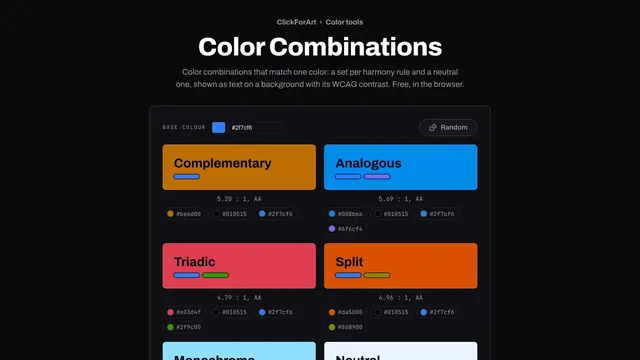
Color Combinations
Color combinations that match one color: a set per harmony rule and a neutral one, shown as text on a background with its WCAG contrast. Free, in the browser.
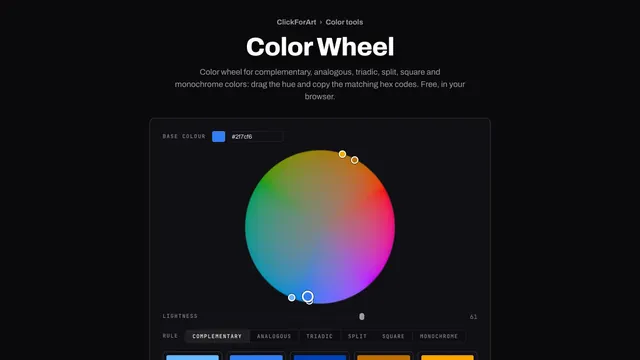
Color Wheel
Color wheel for complementary, analogous, triadic, split, square and monochrome colors: drag the hue and copy the matching hex codes. Free, in your browser.