Tessellation
Tessellation is a pattern of shapes that covers a surface with no gaps or overlaps. Which shapes can do it, the 2023 tile that never repeats, and Escher's way.
What is a tessellation?
A tessellation is a set of shapes that fit together to cover a flat surface completely, with no gaps and no overlaps. Floor tiles, a brick wall, a honeycomb and a chessboard are all tessellations.
The word comes from the Latin tessella, the small square stone used in Roman mosaics. In math the shapes are called tiles whatever they're made of, and a tessellation that repeats in a regular grid is called periodic.
Why do only three regular shapes tile the plane?
Where tiles meet at a corner, their angles have to add up to exactly 360 degrees. An equilateral triangle has 60 degree corners, so six meet at a point. A square has 90, so four meet. A regular hexagon has 120, so three meet.
A regular pentagon's corner is 108 degrees, and 360 isn't a whole multiple of 108, so pentagons always leave a sliver or overlap. Any polygon with more than six sides has corners above 120 degrees, so only two could meet, which is impossible. That leaves exactly three regular tilings.
Bees picked the best of the three. In 1999 the mathematician Thomas Hales proved that regular hexagons divide a plane into equal areas using the least total edge length, which in a hive means the least wax.
Pentagons, and a tile that never repeats
Irregular pentagons can tile, and finding all of them took most of a century. In the 1970s Marjorie Rice, a San Diego homemaker with no math degree, found four new types after reading about the problem in Scientific American. A team at the University of Washington Bothell found a fifteenth type in 2015, and in 2017 Michaël Rao published a computer-assisted proof that there are no more than those fifteen.
In March 2023 another amateur, David Smith, found a 13-sided shape now called the hat. It covers the plane forever but never in a repeating pattern, the first single tile proven to do so. He worked on it with three mathematicians, and they followed it months later with the spectre, which does the same without needing mirror-image copies.
Escher and the 17 wallpaper groups
M. C. Escher first saw the tiled walls of the Alhambra in Granada in 1922 and went back in 1936 to copy them. He then spent decades turning the abstract Moorish tiles into interlocking lizards, birds and fish. His method was to start from a simple tile such as a square, cut a curve out of one edge and add the same curve to the opposite edge, so the shape still fits its neighbors.
Mathematicians had already counted the ways a pattern can repeat across a plane. There are exactly 17, the wallpaper groups, proved by Evgraf Fedorov in 1891. They differ in which mirrors, rotations and glides they allow, and every repeating wallpaper, tiled floor or textile print belongs to one of them.
Making a tessellation from a photo
The Wallpaper Pattern Maker cuts a motif from your picture and repeats it under any of the 17 groups, from p1 to p6m. Start at the default p4m, then try p6m, which uses a hexagonal grid with six-fold mirrors. Tile size sets one repeat, and Motif X and Motif Y pick which part of the photo becomes the tile, so a face or a flower can sit at the center of each cell.
For a plain honeycomb, the Hexagon Mosaic turns the image into flat hexagons. The Seamless preset sets Border to 0, and Large cells raises Size to 64 so the hexagon grid reads clearly from across a room.
Try it
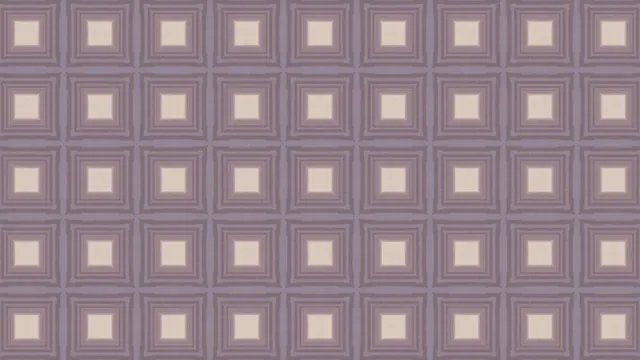
Wallpaper Pattern Maker
Make a wallpaper pattern from any photo: cut a motif and repeat it under one of the 17 wallpaper symmetry groups, p1 to p6m. Works on video too, and it's free.
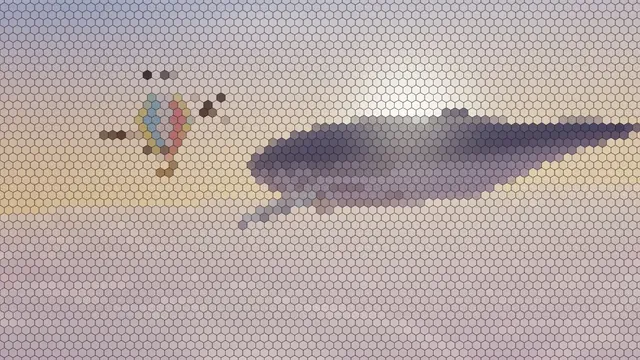
Hexagon Mosaic
Hexagon mosaic that pixelates a photo or video into a honeycomb of flat hexagons, with or without lines between them. Exports a still, MP4 or GIF for free.