Stippling
Stippling is drawing tone out of thousands of small dots. How engravers and science illustrators used it, where hedcuts came from, and how computers place dots.
What is stippling?
Stippling is a way of drawing or engraving in which shading is built entirely out of small dots, packed close where the subject is dark and spread thin where it is light. The dots are all about the same size, so the tone comes from how near together they sit.
It is slow work. A detailed pen stipple can hold tens of thousands of dots, each one a separate touch of the pen. What you get for the effort is soft, even shading without the direction that hatched lines always have.
Where did stippling come from?
Engravers in early 16th-century Italy, such as the Venetian Giulio Campagnola, used dot work to model soft flesh in their prints. The technique peaked in 18th-century London, where stipple engraving, made popular by the Italian-born Francesco Bartolozzi, imitated the softness of chalk drawings and sold in great numbers as decorative prints.
Scientific illustrators took it up for a practical reason. A drawing made only of black dots on white paper can be printed as plain line art, with no halftone screen, and it survives being shrunk. Insects, shells and archaeological finds are still often drawn this way.
How are Wall Street Journal portraits drawn?
The small ink portraits in the Wall Street Journal, called hedcuts, mix stippling with fine hatching. The style dates to 1979, when the illustrator Kevin Sprouls brought dot drawings to the paper, and the editors liked that it recalled the engraved portraits on banknotes.
How does a computer place stipple dots?
Dropping dots at random leaves clumps and holes no illustrator would allow. Hand stipplers space their dots evenly at every density, and computers imitate that with blue noise, a scatter whose dots keep a minimum distance from one another.
Adrian Secord's Weighted Voronoi Stippling, published in 2002, is a well-known method. It scatters dots roughly where the picture is dark, then moves each dot again and again to the darkness-weighted center of its own cell until they settle into an even spread that looks drawn by hand.
Is stippling the same as pointillism?
Both use dots, and they answer different problems. Stippling describes tone, usually with one ink on paper. Pointillist painters set dots of different pure colors side by side so that the hues combine in the eye. Its nearest relative in the digital world is dithering, which also makes gray from dots of a single size and varies only how many there are. Tattoo artists work the same way in dotwork, shading skin with needle dots in place of solid fills.
Making a stipple drawing
Blue Noise Dithering gives the even, unclumped scatter of a hand stipple. Keep the two-color palette, change the swatches to a dark ink such as #1b1a17 and a warm paper such as #f3eee2, and raise Dot size to 3 or 4 so each dot reads as a pen mark. Set Contrast to around 0.2 to clear out the highlights, since stipplers leave the brightest parts as bare paper.
Try it
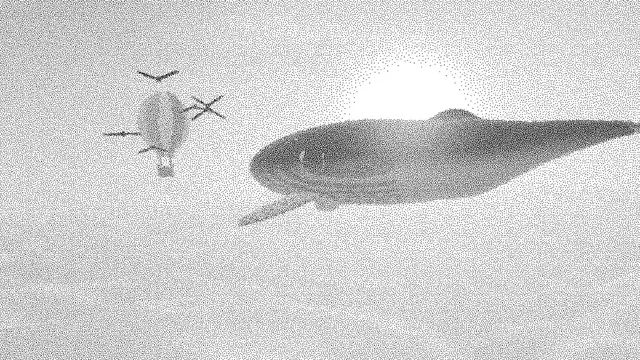
Blue Noise Dithering
Blue noise dithering for images and video: an even, grain-like scatter of dots where a Bayer grid would show its pattern, from a 64x64 void-and-cluster mask.
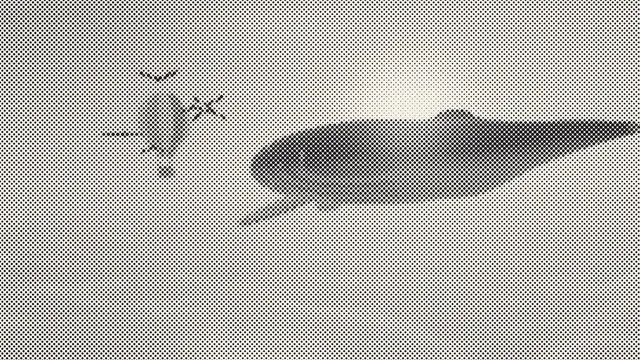
Halftone Generator
Halftone generator for images and video: dots, lines, crosses or diamonds that grow with the tone, for a printed halftone effect. Free, and nothing is uploaded.