Ben-Day Dots
Ben-Day dots are even, same-size dots that print a flat tint. Who Benjamin Day was, how comics built a few dozen colors, and how they differ from halftone.
What are Ben-Day dots?
Ben-Day dots are a pattern of identical, evenly spaced dots used to print a flat area of tint, such as a pink face or a pale blue sky. Every dot in the area is the same size, and that is the difference from a halftone, whose dots change size to follow a photograph's tones.
Lay dots of two inks over each other and you get a third color without a third plate. Red dots over yellow read as an orange skin tone, and sparse cyan dots on white paper read as sky.
Who was Benjamin Day?
Benjamin Henry Day Jr. was an illustrator and printer, and the son of the Benjamin Day who founded the New York newspaper The Sun in 1833. In 1879 he patented a way of putting texture onto a printing plate. A thin sheet with a raised pattern was inked and rubbed onto the plate, which gave an even tint without an engraver cutting every mark by hand.
The patterns weren't only dots. Day's process covered lines, grains and stipples, and commercial engravers used it for all kinds of shading long before comics made the dot version famous.
How did old comic books get their colors?
A colorist painted over a copy of the black line art and marked each area with a code, such as Y2B2 for a light green made of 25% yellow and 25% blue, which is what comics called cyan. The engravers then made a plate for each color ink, with a dot tint at the marked strength in every area.
With tints of only 25%, 50% and 100% to mix from, an interior palette came to a few dozen colors. The Simon and Kirby research at the Jack Kirby Museum counts at most 48 in the Golden Age pages it studied, and only about three dozen in regular use. That small set explains why vintage comics look so alike: the same flesh pink and the same sky blue on page after page, each built from dots you only notice up close.
Did Roy Lichtenstein use Ben-Day dots?
He painted them. Starting with Look Mickey in 1961, Lichtenstein enlarged comic panels onto canvas and painted the dots by hand, and later used perforated stencils so the grid came out even. Dots that were meant to vanish at reading distance became the subject of the picture.
Dots in a real comic are tiny, often too small to see without a magnifier, and printed on top of each other in different inks. Lichtenstein's are large, single-colored and set side by side. His paintings shaped what most people now picture when they hear the term, more than any comic page did.
Making a Ben-Day tint
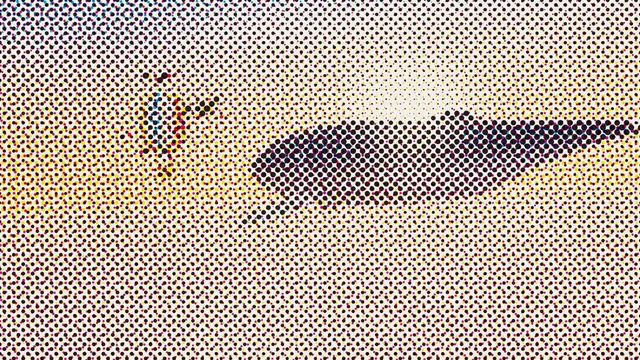
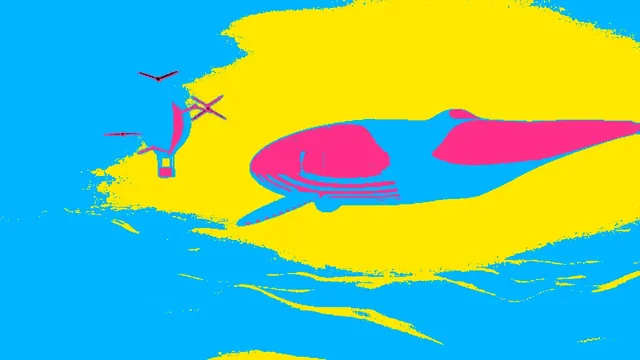
Since Ben-Day dots fill flat areas, flatten the picture first. Run a photo through Pop Art Effect with Softness at 0 so it becomes a handful of flat inks, save it, and open the saved picture in Comic Book Filter. Each flat area now prints as dots of one size, which is exactly an even tint. The Comic preset's Black generation of 1 keeps the shadows in solid black ink, like the inked line art of a printed page.
Try it
Comic Book Filter
Comic book filter for photos and video: big cyan, magenta, yellow and black dots with pure black shadows, like a blown-up vintage comic panel. Exports GIF too.
Pop Art Effect
Pop art effect: turn pictures into flat black, hot pink, cyan and yellow inks, like a Warhol screen print. Pick your own inks, then save a PNG or MP4 for free.