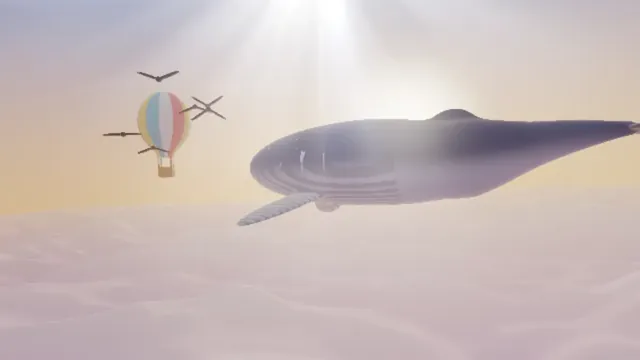
God Rays
God rays are shafts of sunlight made visible by haze, through gaps in clouds or trees. They seem to fan out, yet the beams run parallel; perspective does it.
What are god rays?
God rays are shafts of sunlight you can see in the air, streaming through gaps in clouds, between trees or through a window into a dusty room. Meteorologists call them crepuscular rays, from the Latin for twilight, because they show up best with the sun low in the sky.
They go by plenty of other names. Jacob's ladder comes from the dream in Genesis of a ladder reaching up to heaven, and older paintings use the rays for exactly that kind of scene. An old folk name is the sun drawing water, from the belief that the beams were pulling water up into the clouds.
Why can you see a beam of light at all?
Light traveling through perfectly clean air is invisible from the side. You only see a beam when something in the air scatters part of it toward your eye: dust, smoke, pollen, sea salt or tiny water droplets. Clear air between the beams stays darker because the sun reaching it is blocked by a cloud or a branch.
So god rays need two things at once: haze to light up, and something solid casting shadows through it. A forest after rain, a smoky concert hall and a cathedral with incense all have both. A crisp, dry day with a cloudless sky has neither, which is why the rays feel rare.
Do god rays really spread out from the sun?
No. The sun is about 150 million kilometers away, so its rays reach us practically parallel. They look like a fan for the same reason a long straight road seems to narrow toward the horizon: the parts of the beams far away from you look closer together.
The best proof turns up on some evenings when the rays cross the whole sky. Looking away from the sun, you can see them converge again on the point directly opposite it. Those are called anticrepuscular rays, and they only make sense if the beams were parallel all along.
God rays in film and games
On a film set the look is built with a haze machine and a hard light, often through a window or a cut-out flag. In games the rays became a standard feature in the late 2000s, when graphics cards were fast enough to march samples from each pixel toward the sun and count how many were blocked. In some games the graphics menu even lists the setting as godrays.
How to add god rays to a photo
God Rays Effect lays shafts of light over a picture from a source you place, blended so they can only brighten it. Put Source X and Source Y on the real light in the photo, such as a window or the sun behind a tree, since rays that start from nowhere read as fake straight away.
For a forest, start with the Forest sun preset and its 24 Rays. A Spotty value around 0.6 breaks the beams up the way leaves do. Keep Intensity under 1 on a bright daytime picture, where real rays are faint.