Aspect Ratio
Aspect ratio is the width of an image or screen divided by its height, like 16:9 or 4:3. Where the common ratios came from, and why 16:9 is a compromise.
What is aspect ratio?
Aspect ratio is the proportion between an image's width and its height, written as two numbers with a colon, like 16:9, or as one decimal, like 1.78:1. It describes the shape of a frame without saying anything about its size.
A 1920 by 1080 video and a 1280 by 720 one are both 16:9, since 1920 divided by 1080 and 1280 divided by 720 both give about 1.78. A tall phone video is the same ratio turned on its side, 9:16. Pixel count tells you how sharp a picture can be, and aspect ratio tells you its shape.
Where did 4:3 and 3:2 come from?
Early cinema film was 35 mm wide, and Thomas Edison's lab set a frame four perforations tall, which made pictures close to 4:3. In 1932 the Academy of Motion Picture Arts and Sciences fixed a slightly wider version, about 1.37:1, to leave room for a soundtrack on the film. Television copied the 4:3 shape and kept it for more than half a century.
Still photography got 3:2 from the same film. The Leica cameras of the 1920s ran 35 mm movie stock sideways and exposed a frame 36 by 24 millimeters, and that shape carried over to most digital camera sensors. Phones settled on 4:3 sensors instead, which is why phone and camera photos come out in different shapes.
Why is widescreen 16:9?
In the 1950s cinemas went wide to compete with television. CinemaScope arrived in 1953 with The Robe, and widescreen films have since settled around 2.35 to 2.39:1. By the 1980s TV designers had a problem: one screen had to show both old 4:3 programs and wide movies.
Kerns Powers, an engineer on a SMPTE working group, proposed 16:9 in 1984. It's close to the geometric mean of 4:3 and 2.35:1, the square root of their product, so both kinds of picture lose about the same share of the screen to black bars. It was a compromise between formats from the start.
Paper has one too
An A4 sheet is 210 by 297 millimeters, a ratio of 1 to the square root of 2, about 1:1.414. That ratio is the only one that stays the same when you cut the sheet in half across its long side, so two A5 sheets have exactly the shape of the A4 they came from. The ISO 216 standard builds the whole A series on it, starting from A0, which is one square meter.
US Letter, 8.5 by 11 inches, is about 1:1.29, so a page laid out for A4 never fits Letter exactly and the other way around.
Changing an image's aspect ratio
There are three ways to change a picture's shape: cut part of it away, add bars or a border to fill the space, or stretch it. Stretching distorts everything, so faces get fat or thin, and it's almost never the right choice.
Crop Image cuts to 1:1, 4:5, 3:2, 16:9 or 9:16, or to any box you drag with Free. Resize Image changes the size and leaves the shape alone, because you set the width and the height follows. To get both, crop to the shape first, then resize to the pixel width the platform wants.
Try it
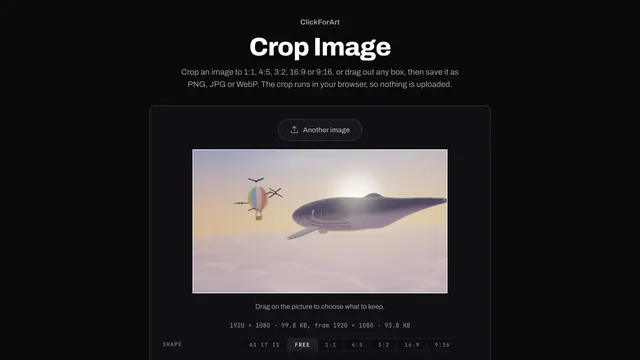
Crop Image
Crop images to 1:1, 4:5, 3:2, 16:9 or 9:16, or drag out any box, then save as PNG, JPG or WebP. Crop a photo online for free, and nothing is uploaded.
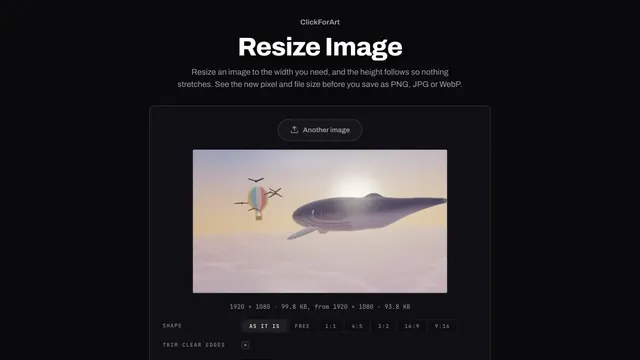
Resize Image
Resize an image online by width, and the height follows so nothing stretches. See the new pixel and file size, then save as PNG, JPG or WebP. Free, no upload.